As urban environments become more complex and densely built, the risk — and potential consequences — of fires in large buildings, high-rises, and mixed-use developments grows substantially. In response, the concept of “smart buildings” — structures equipped with integrated digital, sensor, and automation technologies — has begun to transform how fire safety is designed, implemented, and managed. In this article, we explore how smart buildings are adopting advanced fire safety measures, why the shift matters, and what future innovations may bring.
From Traditional Fire Safety to Smart, Integrated Protection
Traditionally, fire safety in buildings has relied on passive measures (fire-resistant materials, fire doors, firewalls), manual inspection and maintenance of extinguishers, and standalone smoke or heat alarms. While these remain important, they have limitations: delayed detection, human error, periodic inspections, and limited reach.
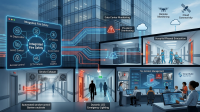
In contrast, smart buildings integrate fire safety as part of a holistic, connected ecosystem — combining sensors, automation, analytics, and building-wide communication. This shift moves safety from reactive (after fire begins) to preventive and responsive — often catching problems early, triggering suppression systems automatically, and guiding people out safely.
Key to this shift is the adoption of digital controls and building management systems (BMS) that unify disparate safety components (alarms, sprinklers, ventilation, access control, emergency signage) under a single intelligent infrastructure.
Core Technologies & Systems in Smart-Building Fire Safety
Here are the main components that modern smart buildings deploy to enhance fire safety:
- IoT-Enabled Early Detection Systems
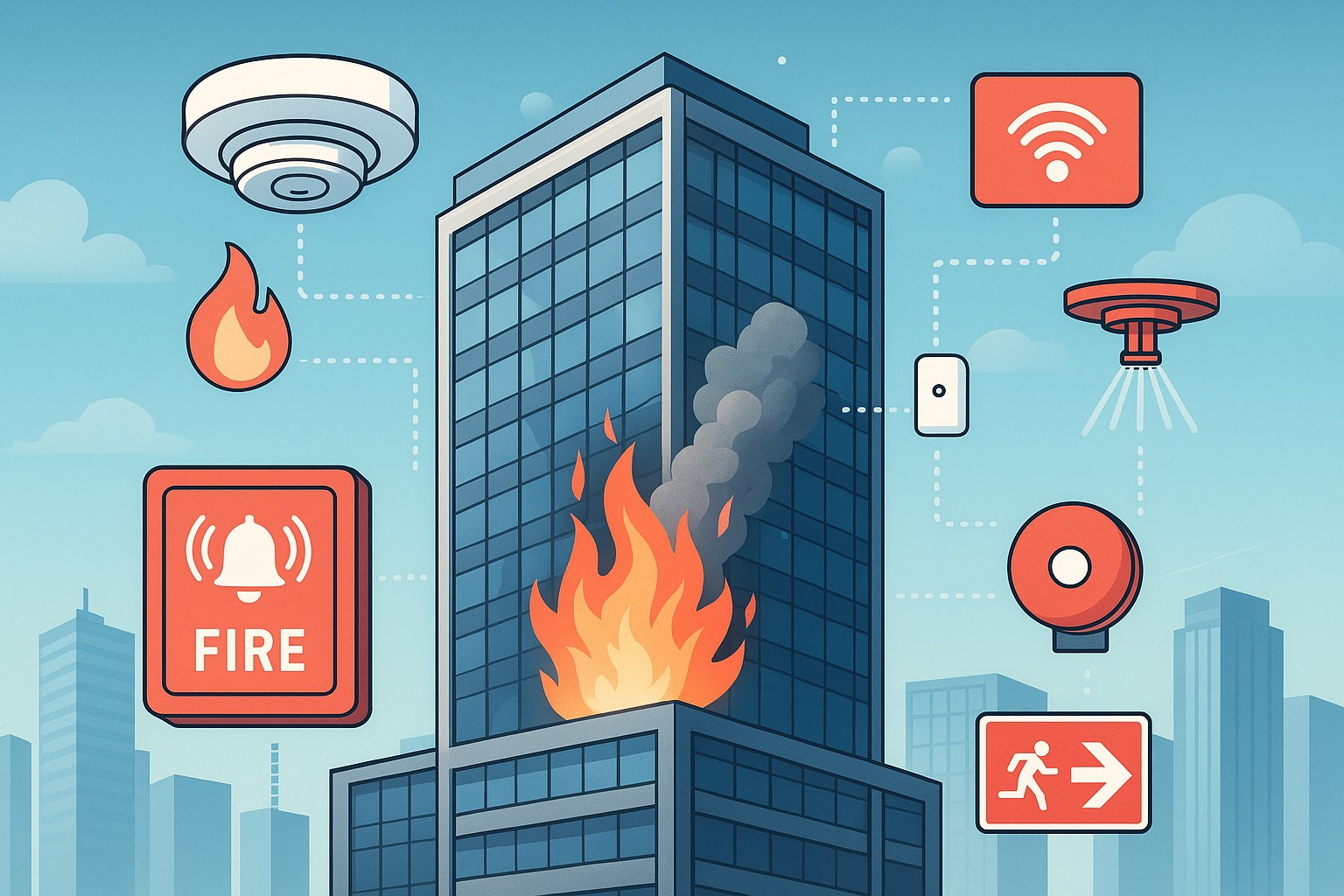
Smart buildings increasingly use networks of interconnected sensors — smoke detectors, flame sensors, heat sensors, gas sensors — integrated via IoT (Internet of Things) to monitor the building 24/7.
Such systems allow for real-time detection of anomalies (like rising temperature, presence of smoke or gas, flame detection), and can trigger alarms, alerts to building managers/security staff, or even notifications to external emergency services.
Some implementations go beyond alerting: certain IoT-based systems link to actuators that can automatically trigger suppression mechanisms or ventilation controls. - Automatic Fire Suppression & Smart Sprinklers
Once a fire or hazardous condition is detected, suppression is often the next crucial step. In smart buildings, suppression systems (sprinklers, water-mist systems, gas- or foam-based suppression) are controlled automatically, often targeted to the specific area with the hazard to minimize damage.
Some modern suppression systems are sensitive — activating only where needed — which reduces collateral damage (e.g., from water) and improves overall safety. - Smart Monitoring, Analytics & Predictive Maintenance
Because all these systems are connected, smart buildings collect vast amounts of data: temperature fluctuations, sensor status, water pressure in sprinklers, airflow and ventilation performance, and more.
With advanced analytics (and in some frameworks, digital-twin modeling), building managers can detect risks before they escalate: for example, an overheating electrical circuit, accumulation of smoke or gas in seldom-used areas, or failures in suppression or ventilation systems.
This predictive maintenance reduces the chances that a safety system fails when needed most. - Integrated Evacuation & Emergency Response Systems
In emergencies, timely and orderly evacuation is often the difference between life and death. Smart buildings enhance evacuation through dynamic signage, wayfinding systems, and real-time control of doors, ventilation, and lighting so escape routes remain safe and visible.
Some fire-evacuation systems even use intelligent algorithms (like hybrid optimization methods) to compute safest, energy-efficient escape routes dynamically — a big advantage in large or complex buildings. - Integration with Other Building Systems (HVAC, Security, Access Control)
Fire safety in smart buildings doesn’t operate in isolation. Instead, it’s closely tied to other building subsystems — heating/ventilation/air-conditioning (HVAC), power management, security, access control, lighting — ensuring a coordinated response: shutting down HVAC to prevent smoke spread, unlocking emergency exits, powering up emergency lighting, broadcasting alarms, etc.
This interconnectedness reduces confusion during emergencies, provides clear instructions to occupants, and improves overall effectiveness of safety measures.
Benefits & Impact of Smart Fire Safety
Adopting advanced fire safety through smart building technologies brings several important advantages:
- Faster Detection and Response: IoT sensors and automatic suppression drastically reduce the time between fire ignition and response, minimizing damage and casualties.
- Reduced False Alarms & Better Reliability: Sensor fusion (smoke + heat + flame + gas) and intelligent analytics help distinguish real threats from false triggers — e.g. preventing unnecessary sprinkler activations.
- Proactive Risk Mitigation: Predictive maintenance and continuous monitoring help catch hazards (like overheating wiring, malfunctioning safety equipment) before they trigger a fire.
- Safer Evacuations: Dynamic evacuation routes, automated safety protocols (ventilation shut-off, emergency lighting, door unlocking) improve occupant safety and reduce panic.
- Efficient Resource Management: For building managers, integrated fire safety systems simplify maintenance, reduce manual inspections, and offer better long-term tracking of safety data and compliance status.
In essence: smart buildings make fire safety more effective, reliable, proactive, and integrated — far beyond what traditional systems alone can achieve.
Real-World & Research Trends — What’s Happening Now?
Several recent academic and industry works highlight how smart fire safety systems are being designed, tested, and deployed:
- A study described a fire suppression system (named SIPEKA) using IoT sensors (smoke, gas, temperature) that — when detecting danger — can automatically activate pumps or sprinklers, while providing real-time monitoring through an Android app. Fire detection in tests occurred in as little as 2.8 seconds, with a suppression success rate of 94.7%.
- Another recent design for multi-sensor, IoT-based detection systems uses sensors for smoke, flame, temperature, sending notifications through messaging apps (e.g. WhatsApp) — offering affordable and accessible fire safety even for residential or small commercial buildings.
- The field is also advancing toward more sophisticated frameworks: for example, a 2024 article in a peer-reviewed journal proposed a “digital-twin-based fire safety management framework,” where a virtual twin of the building monitors and simulates fire scenarios, enabling preemptive analysis and faster response planning.
These trends indicate that smart fire safety is no longer a futuristic idea — it’s being actively researched, refined, and rolled out across residential, commercial, and industrial buildings.
Challenges & Considerations: What Needs Attention
While smart fire safety offers many benefits, there are also important challenges and limitations to consider:
- System Complexity and Maintenance: As buildings rely more on interconnected sensors, suppression systems, and control software, maintenance becomes more crucial. Faulty sensors, lost connectivity, or software bugs can undermine effectiveness.
- Reliability & Redundancy: Unlike simple fire extinguishers, smart systems must function even during power outages, network failures, or other emergencies. This requires robust backups (battery power, redundant sensors, manual overrides).
- Integration & Standards: Integrating fire safety with other building systems (security, HVAC, access control) can create interoperability issues. There’s a need for uniform standards and rigorous testing.
- Data Privacy & Cybersecurity: Smart buildings rely on data and network connectivity — which implies risks: unauthorized access, hacked alarms or suppression systems, false triggers, or system failures due to cyberattacks. Indeed, the wider field of smart-building security has identified these as real concerns.
- Cost and Accessibility: Advanced systems can be expensive to install and maintain. For smaller buildings or residential homes, cost may be a barrier — though there are low-cost, IoT-based approaches being developed.
Therefore, while smart fire safety is powerful, careful design, regular maintenance, and planning for contingencies are essential.
The Future: What’s Next for Smart Fire Safety
Looking ahead, several emerging trends may shape the next generation of fire safety in smart buildings:
- Digital Twin & Simulation-Driven Safety Planning: As noted, digital-twin frameworks will become more common, allowing building managers to simulate fire scenarios, assess risk zones, and optimize suppression and evacuation strategies before incidents occur.
- AI & Predictive Analytics for Risk Detection: AI models can learn from sensor data over time — detecting subtle signs like overheating circuits, patterns of increased gas concentration, or degraded suppression equipment — and predict fire risk before ignition.
- Smart Evacuation & Crowd Management: Using real-time sensor data + intelligent routing algorithms (e.g. PSO/EPC-based pathfinding) to dynamically manage evacuations, even in crowded or complex building layouts.
- Integration with Smart City / Smart Infrastructure: As more buildings become part of a larger smart-city network, fire safety systems can coordinate across buildings — e.g. alert local fire services automatically, share data for pattern analysis, support city-wide emergency response.
- Eco-Friendly, Sensitive Suppression Systems: For sensitive environments (data centers, archives, labs), clean-agent suppression systems (gaseous agents, aerosol-based systems, water-mist) will gain traction — they extinguish fires without damaging electronics or causing excessive water damage.
Conclusion
Smart buildings represent a paradigm shift in how we think about fire safety — from isolated alarms and extinguishers to a deeply integrated, data-driven ecosystem that can detect, respond, prevent, and even predict fire hazards.
By combining IoT sensors, automated suppression systems, real-time monitoring, analytics, and intelligent evacuation control, these buildings significantly raise the bar for safety — potentially saving lives, reducing damage, and offering better protection for occupants and assets.
However, realizing this potential requires careful design, ongoing maintenance, robust cybersecurity, and thoughtful integration. As technology progresses — especially in AI, digital-twin simulations, and cross-building networks — smart fire safety will likely become standard rather than novel — shaping the future of safe, resilient, and intelligent buildings worldwide.