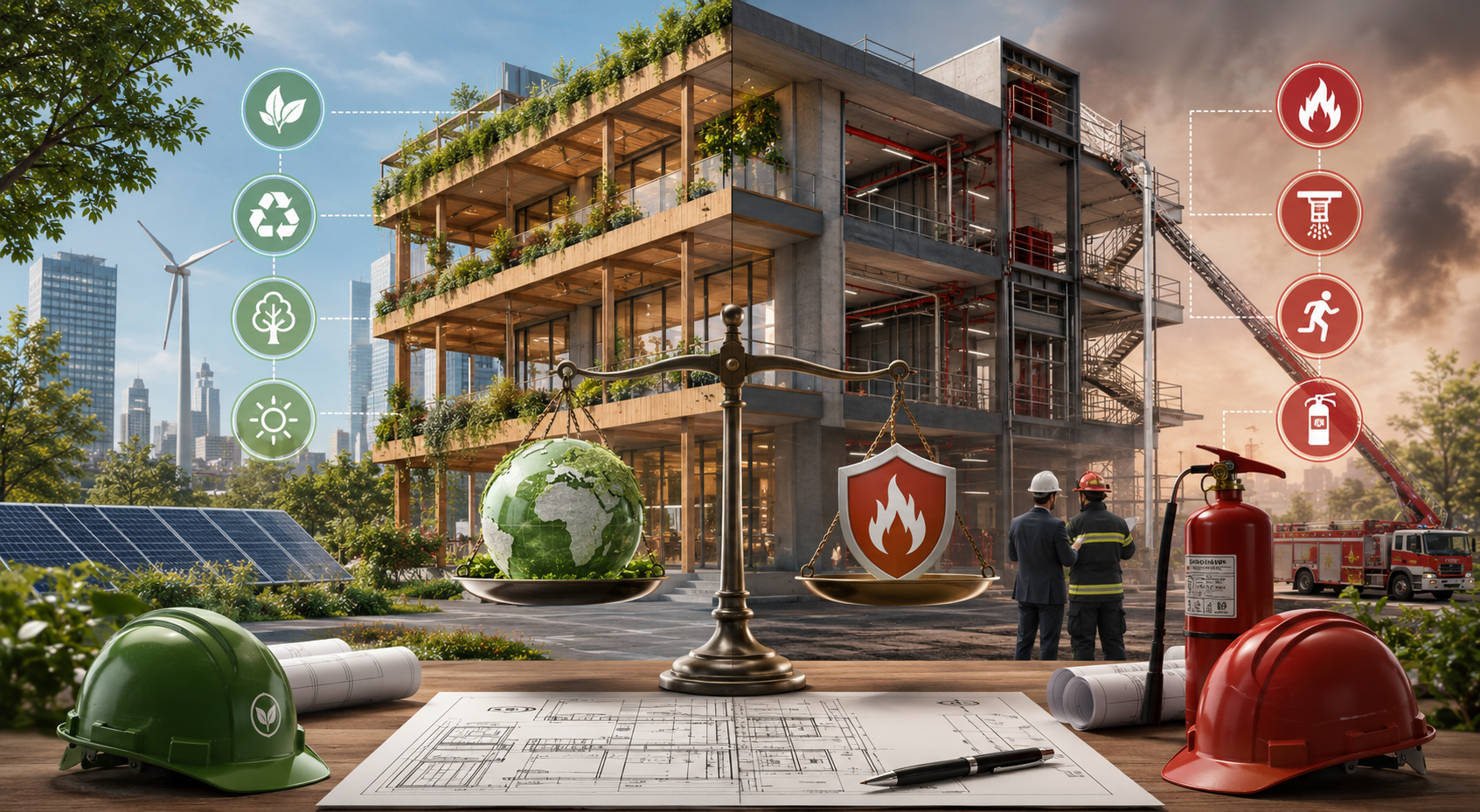
Sustainability and fire safety are both essential pillars of modern building design and urban development. One focuses on reducing environmental impact and improving energy efficiency, while the other prioritizes protecting lives, property, and infrastructure from fire hazards. The challenge is that these goals can sometimes conflict, requiring careful coordination between designers, regulators, and engineers.
The Rise of Sustainable Building Standards
Over the past two decades, sustainable development has become a central focus in construction and urban planning. Frameworks such as the United Nations Sustainable Development Goals (SDGs), particularly SDG 11 (Sustainable Cities and Communities), encourage cities to become more resource-efficient and resilient.
In the building sector, certification systems like U.S. Green Building Council’s LEED (Leadership in Energy and Environmental Design) have pushed architects toward:
- Lower carbon materials (e.g., recycled steel, engineered timber)
- Improved insulation and airtight building envelopes
- Reduced energy consumption through passive design
- Integration of renewable energy systems
However, many of these innovations introduce new fire safety considerations, especially when using novel materials or highly sealed structures.
Fire Safety Regulations and Their Core Purpose
Fire safety standards exist to ensure that buildings can prevent, detect, and withstand fire long enough to allow safe evacuation and emergency response. Key frameworks include those developed by the National Fire Protection Association (NFPA), along with national building codes across different countries.
Fire regulations typically address:
- Material flammability and combustibility
- Smoke development and toxicity
- Fire compartmentalization and escape routes
- Active systems like sprinklers and alarms
- Structural fire resistance ratings
These rules are often conservative by design, prioritizing worst-case safety scenarios over experimental efficiency.
Where Sustainability and Fire Safety Can Conflict
Conflicts often arise when sustainable design strategies introduce new fire-related risks or complicate compliance with strict codes.
- Use of Engineered Timber and Bio-based Materials
Mass timber and other bio-based materials are popular for their low carbon footprint. However, regulators often require additional testing because of concerns about:- Flame spread rates
- Charring behavior under prolonged heat
- Hidden fire spread within structural cavities
While engineered timber can perform predictably in fire under controlled conditions, approval processes can be slow and highly case-specific.
- Highly Airtight, Energy-Efficient Buildings
Modern energy-efficient buildings reduce air leakage to conserve heating and cooling energy. However, this can impact fire dynamics by:- Increasing smoke concentration
- Reducing natural ventilation during fire events
- Slowing heat dissipation
This means fire modeling becomes more complex and requires advanced simulation techniques.
- Green Insulation and Composite Materials
Sustainable insulation materials, such as cellulose or certain foams made from recycled content, may behave differently under high temperatures compared to traditional mineral wool or fiberglass. This creates uncertainty in regulatory approval.
Engineering Solutions That Bridge Both Goals
Rather than choosing between sustainability and fire safety, modern engineering focuses on integration. Common solutions include:
- Performance-based fire design instead of prescriptive rules
(allowing engineers to prove safety through modeling and testing) - Encapsulation techniques for mass timber structures using fire-resistant layers
- Smart fire detection systems integrated with building automation
- Advanced smoke control systems for airtight buildings
- Material innovation, such as fire-retardant bio-composites
These approaches allow sustainable materials to be used while still meeting safety expectations.
The Role of Codes, Testing, and Innovation
Organizations like the International Organization for Standardization (ISO) play a key role in harmonizing testing methods and safety benchmarks across countries. This is important because inconsistent regulations can slow down the adoption of sustainable construction methods.
In many regions, regulators are increasingly adopting performance-based codes that evaluate how a building behaves in real fire scenarios rather than relying solely on material classifications.
Moving Toward Integrated Design Thinking
The long-term solution lies in collaboration between sustainability experts, fire engineers, architects, and regulators from the earliest design stages. Instead of treating fire safety as a constraint added at the end, it becomes part of the design process itself.
This integrated approach ensures that:
- Carbon reduction targets are met without compromising safety
- New materials are evaluated fairly and scientifically
- Buildings remain both resilient and environmentally responsible
As urban environments grow denser and climate pressures increase, aligning these two priorities becomes not just beneficial—but necessary for safe and sustainable cities.